Education Research
Discipline-based Education Research (DBER) is an interdisciplinary field that combines expertise in a specific academic discipline (such as biology) with research methods from the pedagogical sciences to investigate how students learn and how teaching can be improved. We study how active learning techniques like gamification and the use of technology can be used in biology classrooms to improve student engagement, understanding, and information retention. We are also interested in exploring the impact that artificial intelligence is having on university-level biology education.
Active learning
Active learning is a modernized set of teaching and learning practices that involves engaged participation of students in the classroom. This approach has been shown to generate higher levels of understanding when compared the traditional lecture-style teaching and learning. While "passive learning" simply involves listening and taking notes, active learning includes a wide array of hands-on and/or critical thinking activities that make use of various tools in the classroom. These activities foster higher-order thinking — described in Bloom's Taxonomy as Application, Analysis, Evaluation, and Creation — which lead to better retention and application of information!


The Effects of Artificial Intelligence
A growing number of pedagogical studies show that the widespread use of AI is contributing to reduced critical thinking skills in students, largely due to the software's tendency to agree with the user, a phenomenon now being referred to as "AI Sycophancy." Users are starting to rely on AI-generated responses more and more rather than engaging in their own independent analyses. At the university level, AI tools have transformed how students research, write, and complete assignments, but they have also raised concerns about academic integrity and overreliance on automated thinking. Active learning techniques might provide a solution to this problem. Flipped classrooms, for example, both mitigate AI-assisted cheating and emphasize participation and problem-solving skills, both of which strengthen critical thinking using interactive learning environments.


Using technology to improve biology education
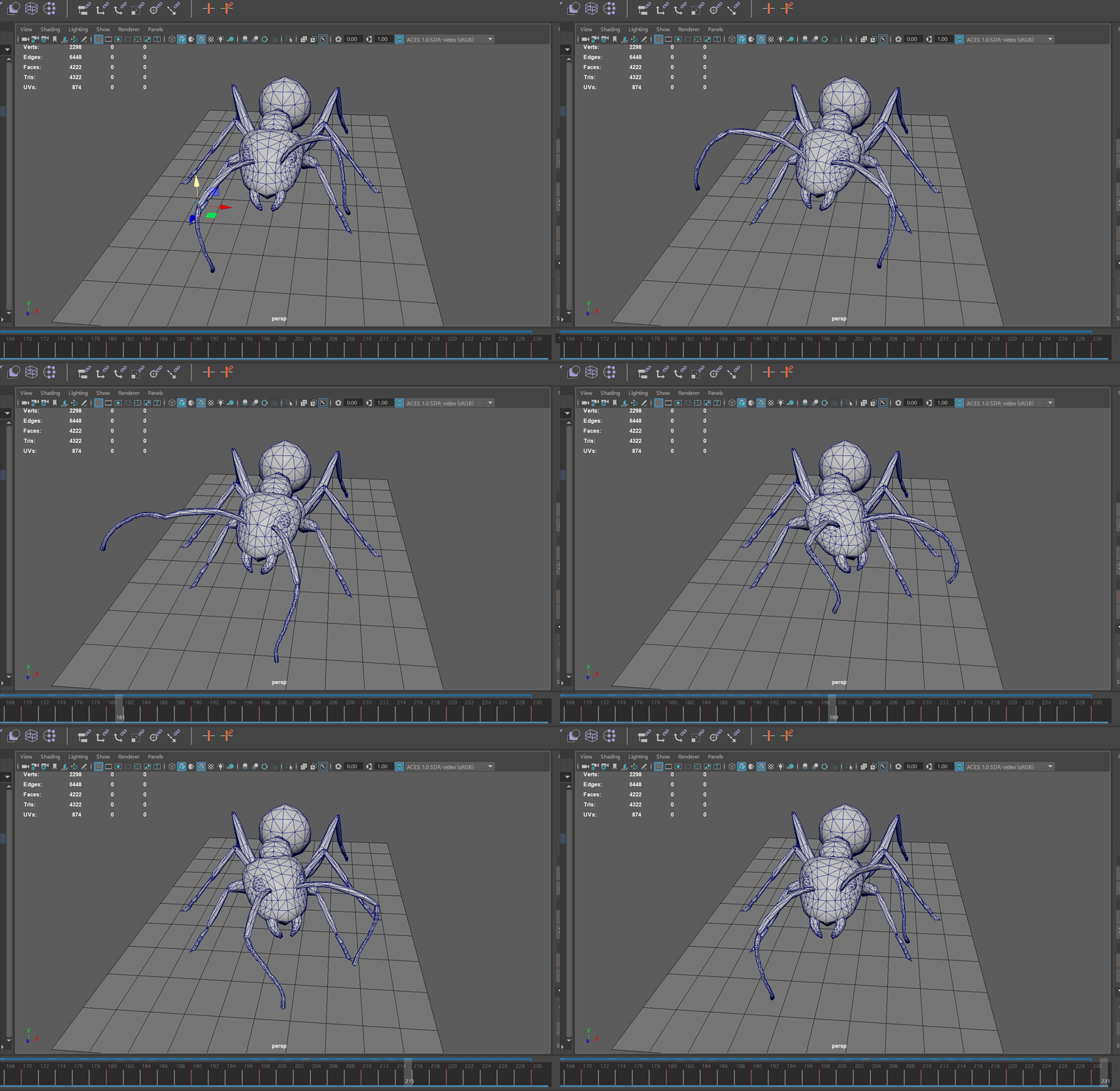
Video games are very popular around the world. At the most basic level, electronic games can be defined as tools with which players generate visual feedback in response to an input — often resulting in the release of dopamine that reinforces specific behaviors. This positive feedback system is precisely what makes video games so incredibly fun! So much so that they have become a staple in many of our lives — particularly for Generation Z and younger individuals born into a world full of smart technology. Our lab is interested in using this technology to improve biology education — both directly through the incorporation of learning material into video games (like in our own virtual reality game about zombie ants called Zombie Ants VR [Meta Link][Steam Link]), and indirectly through the use of gamification principles like reward systems.
Virtual reality (VR) is particularly useful for education. Unlike other video game hardware, VR can invoke a sense of immersion and strong association with visual objects. These features offer unique opportunities to provide users with a new perspective that would otherwise be hard to accomplish in a typical classroom — experiences like visualizing the universe on a galactic scales (e.g., Galactic Center VR) or interacting with life at the microscopic level (e.g., BloodBlast VR). VR also offers alternatives for visual learners and can provide opportunities to those with physical disabilities. In these ways, VR can help bridge inclusivity gaps in education